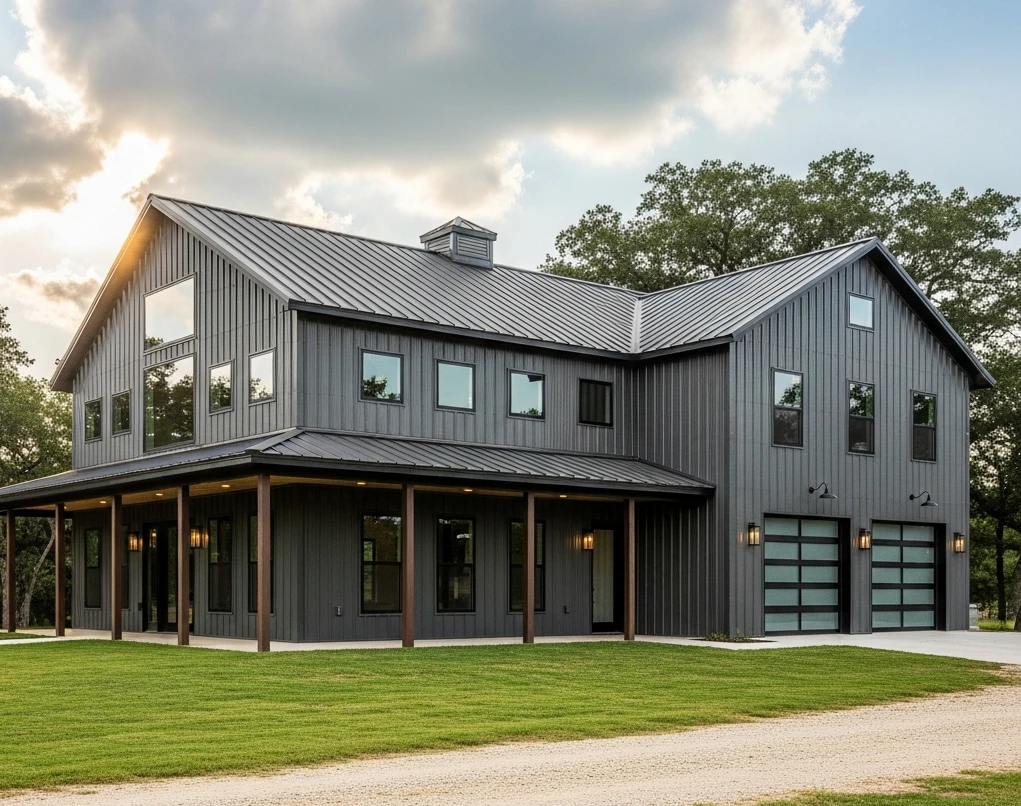
If you’re thinking about building or buying a barndominium, safety is likely one of your first concerns. These homes don’t look like traditional houses, they’re often built with steel instead of wood, and many people are encountering them for the first time. When something feels unfamiliar, it’s natural to question whether it’s truly safe.
The short answer is yes. Barndominiums can be very safe, and in many cases they are just as safe as traditional homes. Some are even safer. The difference comes down to how the building is designed, engineered, and constructed, not whether it’s a barndominium or a conventional house.
This article takes a clear, practical look at barndominium safety. We’ll cover structural strength, extreme weather performance, fire resistance, building codes, and long-term livability so you can make an informed decision without guesswork.
A barndominium is a residential structure that typically uses a steel or metal frame and is finished inside as a full-time home. Some are entirely steel-framed, while others combine steel framing with wood components. Despite the name, modern barndominiums are not barns and are not intended for agricultural use.
They include the same essentials as any house, such as insulation, plumbing, electrical systems, heating and cooling, and finished living spaces. The main difference is the structural system and, often, the exterior materials.
Safety concerns tend to arise because barndominiums fall outside what most people think of as a “normal” home. They’re newer to residential construction, they’re frequently custom-built, and they’re often associated with metal buildings used for commercial or agricultural purposes. None of those factors automatically make them unsafe, but they do mean quality and planning matter more.
When properly engineered, barndominiums are structurally sound and extremely durable. Steel framing has a high strength-to-weight ratio and is widely used in commercial construction for that reason. It doesn’t warp, twist, shrink, or rot the way wood can, and it holds its shape over time.
That said, the safety of a barndominium depends heavily on engineering. Steel structures rely on precise calculations for loads, connections, and anchoring. When those calculations are done correctly, the result is a very strong home. When they’re skipped or rushed, problems can occur.
This is why some barndominiums get a bad reputation. The issue is rarely the steel itself. It’s usually poor planning, under-engineered designs, or builders who aren’t experienced with residential steel construction.
Extreme weather is one of the most common safety concerns, especially in regions prone to tornadoes, hurricanes, or heavy snow. Barndominiums can perform very well in these conditions when they’re designed for the local climate.
In high-wind areas, steel framing offers clear advantages. It resists lateral forces and uplift better than many traditional wood structures when properly anchored to the foundation. However, anchoring is critical. A steel building that isn’t securely tied down is vulnerable, just like any other structure.
In hurricane-prone regions, barndominiums can be a strong option if corrosion resistance and wind ratings are addressed. Proper coatings, reinforced roof systems, and code-compliant connections make a significant difference. These are the same principles used in commercial buildings along the coast.
For cold climates and snowy regions, roof design is key. Metal roofs shed snow more easily than many traditional roofing materials, which can reduce load buildup. As long as the roof is engineered for local snow loads and has the right pitch, barndominiums handle winter conditions well.
Fire resistance is one area where barndominiums often have an edge. Steel does not burn, which means the primary structural frame of a barndominium won’t ignite or contribute fuel to a fire.
This doesn’t mean a barndominium is fireproof. Interior materials such as drywall, insulation, flooring, furniture, and cabinetry can still burn, and high temperatures can weaken steel over time. However, the lack of combustible framing reduces the risk of rapid structural collapse.
With proper fire-rated materials, smoke detectors, and standard safety measures, barndominiums can meet or exceed the fire safety performance of traditional wood-framed homes.
Lightning safety is another common concern, especially for homes built with steel. While it may seem counterintuitive, metal structures are not inherently more dangerous during lightning storms. In fact, steel buildings are typically grounded as part of the electrical system, which helps safely direct electrical energy into the ground.
If lightning strikes a steel-framed barndominium, the electricity travels through the structure and grounding system rather than through the living space. This is similar to how lightning protection works in commercial buildings and aircraft. The key factor is proper grounding and electrical installation, which should always be handled by licensed professionals.
As with any home, surge protection, proper wiring, and code-compliant electrical systems are essential. When those elements are in place, barndominiums are no more vulnerable to lightning than traditional houses.
One overlooked safety advantage of barndominiums is their resistance to pests. Steel framing does not attract termites, carpenter ants, rodents, or other wood-destroying insects. Over time, pest damage can compromise the structural integrity of wood-framed homes, especially in warm or humid climates.
While interior finishes like drywall and cabinetry can still be damaged if pests gain access, the core structure of a steel-framed barndominium remains unaffected. This adds a layer of long-term safety and durability that many homeowners don’t consider until they’ve dealt with costly pest repairs elsewhere.
Proper sealing, insulation, and exterior detailing still matter, but steel eliminates one of the most common hidden risks in residential construction.
Barndominiums can meet residential building codes, but they must be designed to do so from the start. There is no special barndominium code. Instead, these homes are reviewed under the same residential standards used for conventional houses.
The challenge is that not all jurisdictions are equally familiar with steel-framed homes. Zoning rules, minimum square footage requirements, and exterior appearance regulations can vary widely. These are legal and planning issues rather than safety issues, but they affect whether a project moves forward smoothly.
When plans are engineered, submitted correctly, and built to code, inspections for barndominiums are generally the same as for any other home. Problems usually arise when builders try to treat a residential barndominium like a simple metal shed rather than a house.
Long-term safety and comfort depend heavily on insulation, moisture control, and ventilation. Metal buildings can trap condensation if these elements are poorly designed, which can lead to mold or indoor air quality issues.
When proper vapor barriers, insulation systems, and ventilation strategies are used, barndominiums are no more prone to moisture problems than traditional homes. In fact, many perform exceptionally well in terms of energy efficiency and indoor comfort.
Temperature control is also a common concern. With the right insulation and HVAC design, barndominiums maintain stable indoor temperatures year-round and can be very comfortable in both hot and cold climates.
Another factor tied to safety is how a home holds up over time. Steel-framed barndominiums typically require less structural maintenance than wood-framed houses. They are not subject to rot, splitting, or gradual weakening caused by moisture exposure.
That said, long-term safety still depends on routine upkeep. Exterior metal panels should be inspected periodically for damage, fasteners should remain secure, and coatings should be maintained to prevent corrosion in harsh environments. These tasks are generally straightforward and predictable.
When maintained properly, steel structures can last for decades with minimal degradation, which supports both safety and resale value.
Safety isn’t just about how a home performs physically. It also affects insurance and financing. In the past, some insurance companies were hesitant to cover barndominiums due to unfamiliarity. That has changed significantly as steel-framed homes have become more common.
Today, many insurers offer standard homeowners policies for barndominiums, especially when they are built to residential codes and used as primary residences. In some cases, steel construction can even lower insurance premiums because of improved fire resistance and durability.
Financing can still vary by lender, but homes with engineered plans, permits, and certificates of occupancy are generally treated like any other custom-built house. From a safety and risk perspective, documentation and compliance matter far more than the label “barndominium.”
Safety also plays a role in resale. A home that feels unconventional but is clearly well-built tends to inspire confidence rather than concern. Buyers are more likely to focus on safety when documentation is missing or construction quality is unclear.
Barndominiums with engineered plans, inspection records, and clear proof of code compliance tend to perform better on the resale market. From a safety standpoint, transparency matters. When future buyers can see that the home was designed correctly from the start, concerns about steel construction usually fade.
As barndominiums become more common, buyer familiarity continues to improve, further reducing hesitation.
The most significant risks don’t come from steel or metal construction. They come from decisions made during planning and building. Skipping engineering to save money, using builders without residential steel experience, or ignoring local climate requirements can all compromise safety.
Cutting corners on foundations, anchoring, insulation, or ventilation can turn a strong structural concept into a problematic home. When those areas are handled correctly, barndominiums are reliable and durable long-term residences.
From a structural and fire-resistance standpoint, a properly built barndominium can be as safe as or safer than a traditional home. Steel framing offers durability, pest resistance, and long-term stability that many homeowners value.
Traditional homes benefit from familiarity, easier financing, and a larger pool of builders. Safety ultimately depends less on the type of home and more on whether it’s built correctly. A well-built barndominium and a well-built conventional home both meet high safety standards.
One of the biggest safety differences between barndominiums comes down to where the building system originates. Not all metal buildings are designed for residential use, and not all suppliers account for local weather, wind loads, or code requirements.
Working with an experienced provider likeBluebird Building Systems helps reduce many of the risks discussed throughout this article. Their buildings are engineered with residential applications in mind, designed to meet local codes, and tailored to regional climate demands. That upfront engineering plays a major role in long-term safety.
When the building system itself is designed correctly, builders can focus on proper installation rather than trying to adapt a structure that wasn’t meant to be a home.
Yes. Barndominiums are safe when they are engineered properly, built to code, and designed for the environment they’re in. Most concerns stem from poor execution, not from the concept of a steel-framed home.
If safety is a priority, the focus should always be on planning, engineering, and construction quality rather than on whether a home looks traditional.
Barndominiums are not unsafe by nature. In fact, when they’re properly engineered and built to code, they can be just as safe, if not safer, than many traditional homes. Steel framing, strong foundations, and smart design choices all contribute to long-term durability and protection from fire, weather, and structural issues.
What ultimately determines safety isn’t the idea of a barndominium. It’s who designs it, how it’s engineered, and whether shortcuts are avoided during construction.
That’s where experienced providers like Bluebird Building Systems make a difference. Their buildings are engineered to meet local codes, designed for regional weather conditions, and built with quality materials that support long-term residential use. For homeowners who want the strength of steel without guessing or cutting corners, that foundation matters.
If you’re considering a barndominium and want to prioritize safety from the start, explore your options with Bluebird Building Systems and get a building designed for where and how you actually live.
Yes. Steel buildings are grounded, which helps direct lightning safely into the ground rather than through the structure.
Not when properly coated and maintained. Modern steel systems are designed for decades of use.
Yes. There’s nothing inherently unsafe about them when built to residential standards.
Yes, provided they are insulated correctly and designed for snow loads and thermal performance.